



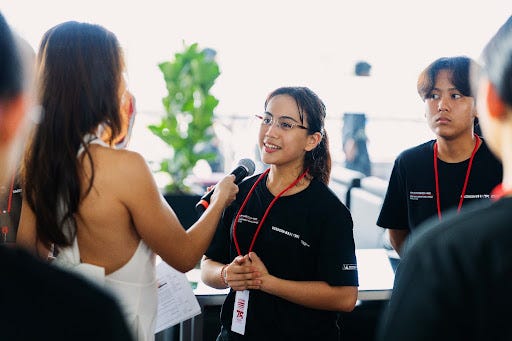
Most professional drivers start young, racing go-karts as soon as they can grip a steering wheel. For Genevieve Ooi, motorsport was a dormant passion waiting to be unlocked. She spent most of her early life in a tutu; dance was all she knew. That changed at 12 when her dad gifted her a Logitech G29 for Christmas, and the rest is history.
Today, she is rewriting the traditional racing pipeline. Moving from competitive sim racing, where she secured Sarawak’s historic first e-sports gold at SUKMA 2026, to the physical tarmac, the 21-year-old Sarawakian proves that digital racecraft translates to real-world speed. As a standout in Toyota’s Young Talent Development Programme and a podium finisher in the Malaysia Touring Car Championship (MTCC), she bypassed the conventional karting route entirely.
But the leap from simulator to Sepang demands more than raw pace. It requires physical conditioning, extreme mental compartmentalisation, and recalibrating the very real risks of Turn 1. We spoke with Genevieve about navigating paddock scepticism, balancing esports with physical racing, and her ultimate goal: being known simply as the fastest driver on the grid.
Transitioning From Dance To Sim Racing
Growing up, Genevieve’s world revolved around the performing arts, spending most of her life in a tutu rather than a race suit. “Dance was all I knew. I enjoyed performing arts. I did ballet, contemporary, jazz, cultural, anything under the sun,” she shares. “I starred in several musical productions back in school. Racing was nothing but a ‘what if’ at the back of my head.”
Even so, she recalls stories of herself as a kid playing racing games against her grandmother, allocating time slots to play between her Barbie dolls and the Hot Wheels set she borrowed from her cousin. At 12, that dormant passion finally took the wheel when she received a Logitech G29 as a Christmas gift from her dad.
Without the ability to race other players online due to a lack of PlayStation Plus, her casual virtual Sunday drives became a way for her to explore the most iconic tracks in the world. Soon, she found herself participating in her first sim racing event: TGR Malaysia’s GT Cup Campus Tour. Designed to bring the thrill of simulator racing directly to university students, it was here that she truly realised the depth of her passion for the sport.
Sim racing also provided a profound escape during a difficult period in her A-Levels. Struggling to find her place in college, she found sanctuary on the digital track.
“After rediscovering sim racing, it became my escape from reality. A place where nothing else mattered; just me and the car. I was fully in control of the narrative and pace I was to set. After a while, I realised that this suppressed dream of mine (becoming a racecar driver) could actually materialize.”
Thriving On Track
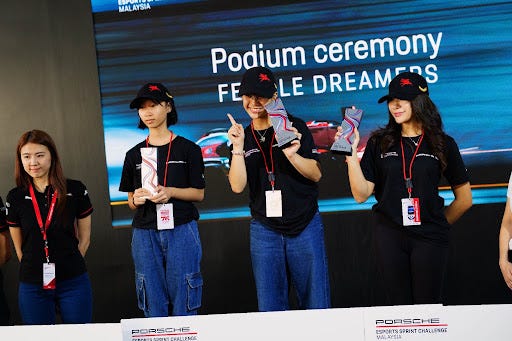
Genevieve’s digital racecraft culminated in a historic victory when she secured Sarawak’s first-ever e-sports gold medal at SUKMA 2026, a deeply personal triumph dedicated to her late grandfather. She further cemented her esports prowess by being crowned champion of the “Female Dreamers” category at the Porsche Esports Sprint Challenge Malaysia (PESCM).
The leap from the simulator to physical circuits, however, was sparked by a single, life-changing question.
“It was when somebody had asked me, ‘Genna, how would you like to race at Sepang?’ It was then that Axle Sports gave me the opportunity to race in real life, and my whole world changed. They didn’t just give me the golden opportunity to realise a pipe dream; they pushed me to work harder to become the best.”
Although the Sarawakian does not have a background in traditional karting, she got her start at the Malaysian Speed Festival racing in Proton Sagas. The car was slower and the races were shorter, serving as a vital introduction for her body into the physical demands of motorsports. This breakthrough eventually led to a seat in Toyota’s Young Talent Development Programme.
Designed for promising young drivers with backgrounds solely in karting or sim racing, the programme puts these rookies through an intensive motorsports bootcamp mentored by Malaysia’s first and only F1 driver, Alex Yoong.
Graduates receive a fully funded race seat to compete in the Rookie Class of the Toyota Vios Challenge, which is where Genevieve made her mark. Reflecting on her experience, the racer believes the steepest learning curve she encountered was learning to cope under the immense pressure.
“I’d like to think of myself as an ambitious person. I get disappointed when I don’t achieve the goal I set out to achieve. When I see other drivers get it quicker than I do, I start to get frustrated, and that leads to a decline in my performance.”
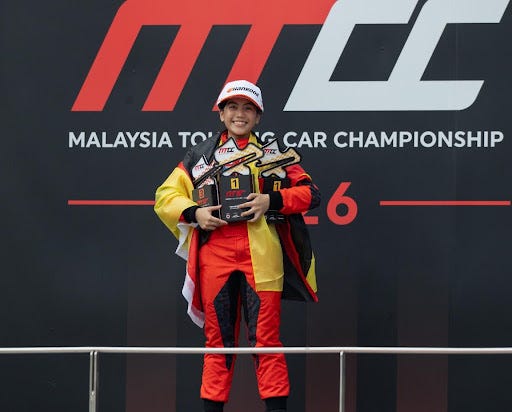
Some of her most notable achievements on track include securing a double podium finish (P2 and P3) during Round 2 of the 2026 Malaysia Touring Car Championship (MTCC), standing as the sole female driver in the M-Touring 2-V Class. Beyond the MTCC, competing in the Rookie Class of the fiercely competitive Toyota Vios Challenge tested her limits, requiring her to survive gruelling heat and one-hour endurance stints.
Bridging the Gap Between the Virtual and Real World
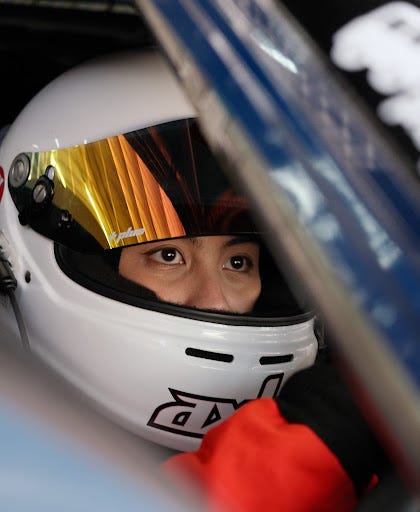
Sim racing has not only helped make the sport more accessible, but it has also become a tool for drivers like Genevieve to develop their racecraft. Training in a virtual environment helps her stay sharp when analysing situations upfront and allows her to become braver when making overtakes or defending.
“I do feel people underestimate the importance of training on the sim and what it could potentially do to your performance. The sim is perfect to train for unsuspecting incidents and drivers; at least you can press restart. In real life, you only have thoughts and prayers.”
As an active sim racer with two championship wins to his name, Dhanesh Wigneswaran notes that sim racers rely on virtual data to build a highly analytical mindset. He shares: “If we have practised for a real-life race on the sim beforehand, then when we go to the real track, we can already analyse how we will tackle the race based on the data we have collected from the sim and try and correlate it to real life.”
Still, adapting to the reality of racing on track affected Genevieve during the early stages of her racing career. Driving conservatively caused her to lose out on many positions (or a guaranteed podium) due to the fear of footing the repair bills if a crash were to happen.
“However, I realised, how would you know where your limits are if you never push? What do I gain out of staying behind and going for a Sunday drive? When I got selected for the TGR Rookie programme, it really gave me the opportunity to fight as hard as I could without having to worry about paying for repairs. I really discovered my limits.”
One of the most unique challenges in Genevieve’s racing career came when she had to balance her time between three competitions: the title-deciding Round 4 season finale of the Malaysia Touring Car Championship, the Grand Finals of PESCM, and SUKMA. With limited time, she poured her heart and soul into preparing for SUKMA, leaving her with little to no practice or preparation for the other two competitions.
“SUKMA was extremely challenging, especially with the thought of Porsche and MTCC in mind. I told myself to take one day at a time. It was the only thing I could do,” she recalls. “After SUKMA was over, there was no break. The very next day, I had to completely shift my mind and my focus to the race (MTCC) weekend, this time hopping into the car with zero practice or preparation.”
Despite securing a podium in the MTCC, Genevieve did not participate in the podium ceremony. Instead, she rushed to the Porsche esports venue, still in her race suit, fresh out of the car, and extremely tired. Having driven a real car, she described the MTCC as the best warm-up for PESCM.

Being A Woman In Motorsports
Early in her racing career, Genevieve could sense the scepticism. While nobody openly questioned her place as a female driver, the silence and stares spoke volumes. Rather than demanding respect, she earned it by delivering results and proving her pace.
“Over time, I started to gain the respect of my fellow rivals by proving myself out on track. And that’s the beautiful part. [They] pushed me to become the driver I am today and I am eternally grateful for their sportsmanship and respect,” she notes.
Genevieve accepts that some will always doubt whether female drivers can be as fast as their male counterparts, but she fully intends to keep proving them wrong.
Even as series like F1 Academy gain global traction and place a massive spotlight on female talent, the Sarawakian remains unfazed. After all, her goal was never to be the fastest female driver; it was simply to be the fastest driver.
“By aiming to be the best female talent, I would already be further exacerbating the idea that men and women cannot be equals on track, which directly conflicts with the equality that women in motorsports, feminists, and society have worked so hard for.”
Her advice for young girls eyeing a motorsport career is simple: block out the negativity and put in the work. The sport demands immense sacrifice, but resilience always pays off.
“I’d like to think of the analogy of digging for diamonds. To get to it, you need hard labour of digging through dirt and rock to reach it,” she shares. “But many stop right before they hit the diamonds. Never stop, no matter how hard it is. And remember, diamonds are formed under pressure.”