



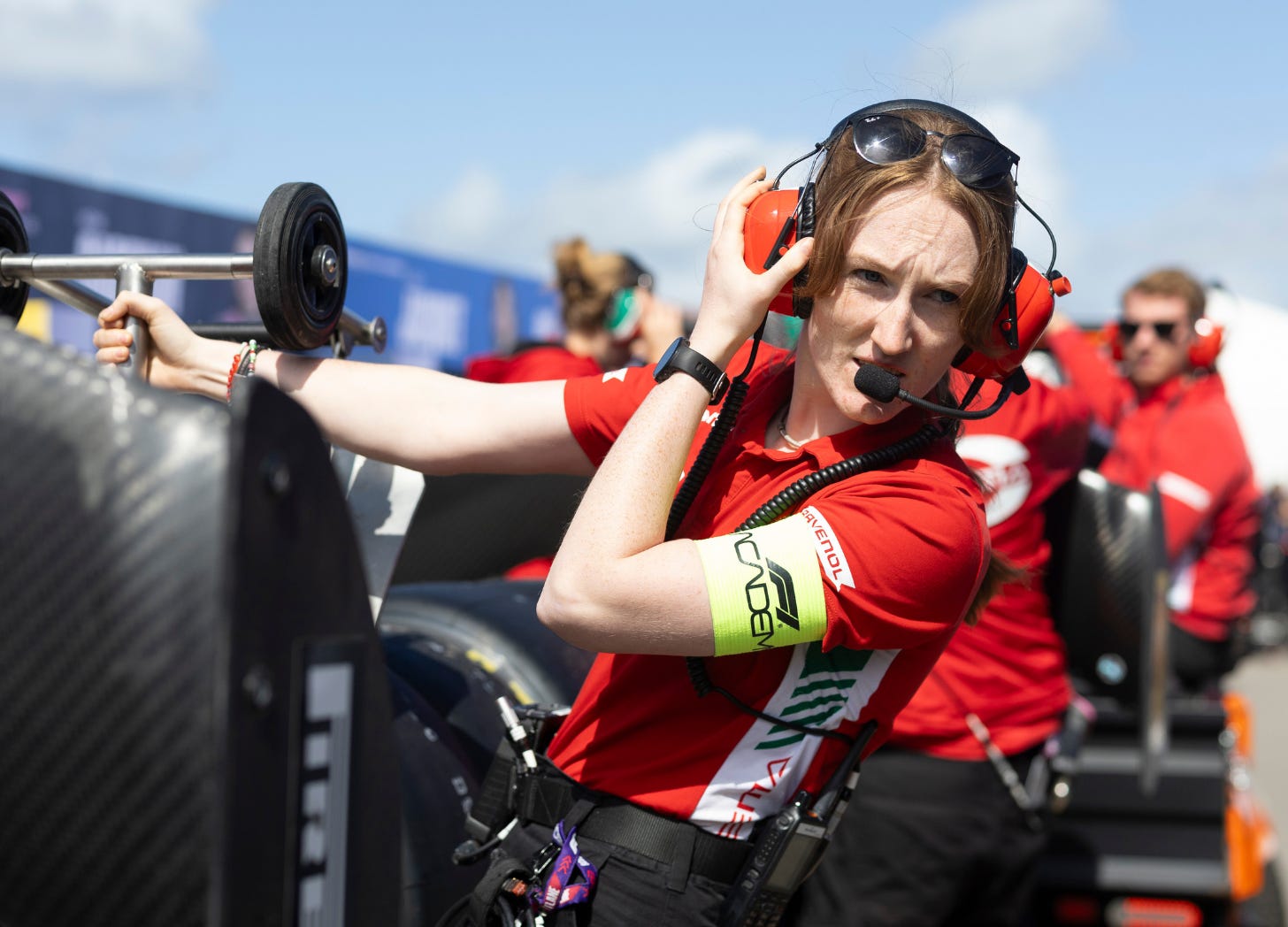
In motorsport, data is everywhere. Engineers can track tyre temperatures, throttle application, and braking zones down to the millisecond. But a screen full of squiggly lines only tells half the story. The real tension on the pit wall comes down to a constant choice: when do you trust the cold telemetry, and when do you lean entirely on human intuition?
For Eimear O’Connor, Race Engineer at PREMA Racing, striking that balance is the job. Speaking with us behind the garage during the last Dutch Grand Prix in Zandvoort, she unpacks her distinct philosophy.
Now in her third year as a Race Engineer in F1 ACADEMY, she approaches the paddock with a clear mindset: a driver is more than someone executing a pre-planned strategy. “They are part of the car, and ultimately they are the best sensor you probably will have in the car,” she shares. Extracting peak performance takes more than a flawless setup. It requires absolute trust, knowing how to read a driver, and putting in the invisible work long before the cars ever reach the glamour of the starting grid.
Life As A Race Engineer In F1 ACADEMY
The race weekend starts back at the workshop with a post-mortem of the previous race, auditing mechanical health, analysing setup choices, and running drivers through simulator sessions. Even when teams are not returning to the same track, some data carries over.
“We normally get the drivers to come to the simulator, so we would prepare some setups for them to run,” Eimear explains. “It’s mainly just track learning, but we might test some setup items as well, depending on whether there’s something that we could consider doing.”
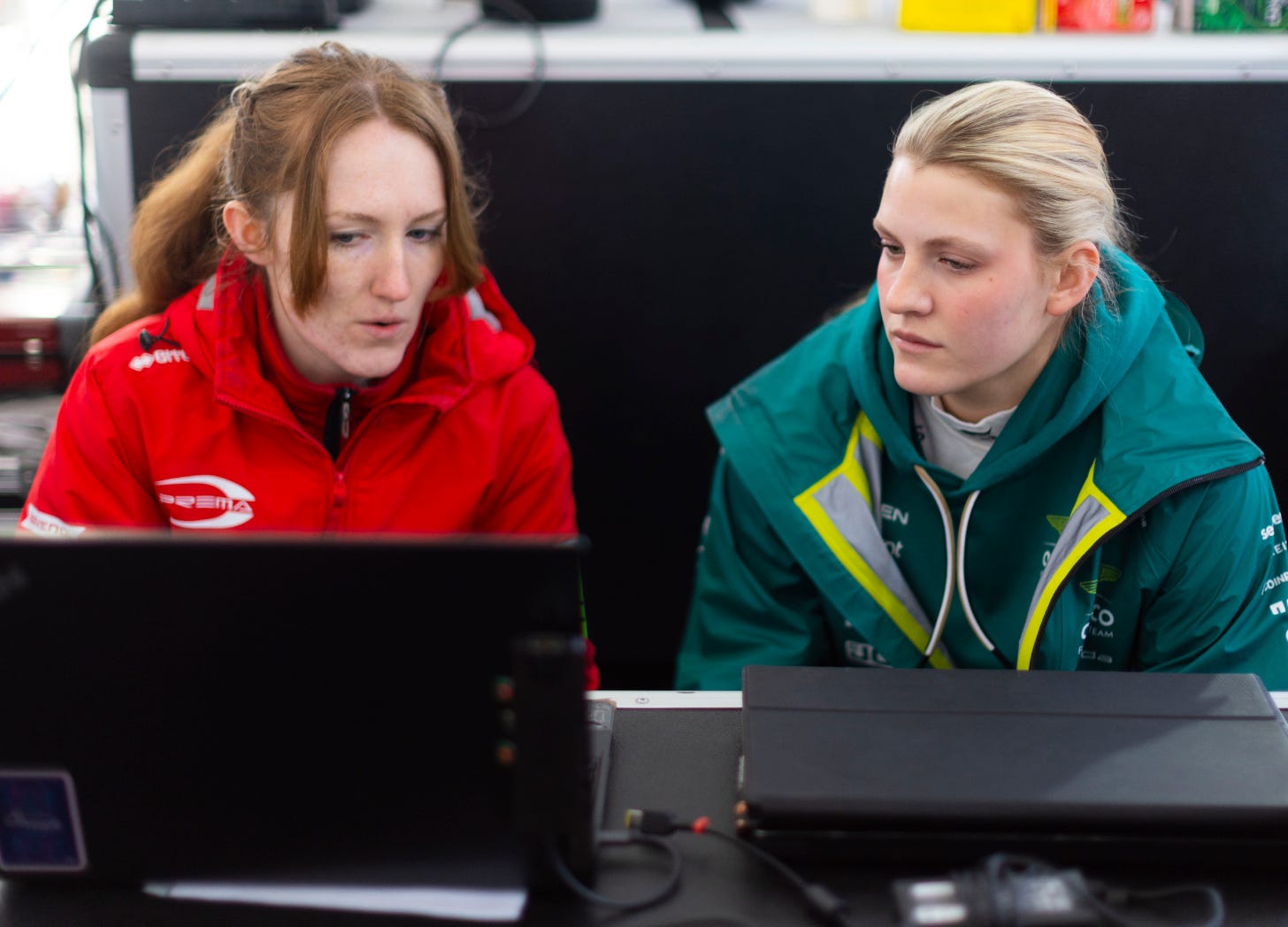
By the time the team arrives at the paddock, time is the enemy. Since teams do not have their cars in the workshop to prepare setups, they operate entirely out of freight boxes. With only one Free Practice (FP) session each race weekend, there is a narrow window to install everything on the first day “Beyond setting up the car, it’s just getting into the race weekend and trying to win,” she notes.
Having only one FP also means teams must find ways to maximise limited track time. This turns the track walk into a strategic tool rather than a simple bonding exercise. In Zandvoort, Eimear combines physical track conditions with F1 ACADEMY historical data from the past three years to give her drivers a head start, especially important in a track where the weather is unpredictable.
“We have the video from the onboard of the wet from 2024,” she notes, pointing out where puddles typically form. “Because they only have a limited time in FP, getting them into the right headspace to try and get the maximum out of the car immediately from the off is really important.”
This intense, hands-on environment demands engineers who can manage every aspect of the machine and the driver. It is exactly why Eimear is in no rush to climb the ladder to Formula 1 (F1).
While she acknowledges F1 as the ceiling of motorsport and would take the opportunity when it presents itself, she prefers the autonomy of junior categories, or even other series such as Formula E, IndyCar, or the World Endurance Championship.
“Because the teams in F1 are so big, you get very streamlined very quickly,” she says, reflecting on her career trajectory. “Keeping my options open and progressing technically is really important. Moving up the ladder to regional F3, F2 is ultimately the goal for me, and then if at some point in that career F1 comes knocking, I would probably go for it.”
Translating Trust into Lap Times
As a Race Engineer with three seasons of F1 ACADEMY under her belt, Eimear knows what a winning partnership looks like. Her first two seasons paired her with formidable talent: Maya Weug, the 2025 Vice Champion, and Nina Gademan, who recently secured a memorable double podium at her home race in Zandvoort.
Working with Maya set an immediate benchmark. Eimear remembers her as one of the most committed drivers she has ever partnered with. That relentless drive created a foundation that forced Eimear to raise her own game to match the intensity.
“Honestly, I think I got a bit spoiled with her being my first driver,” she shares. “It set a very good foundation and a benchmark for the standard you have to work to. When you have a driver that committed, you need to step up as an engineer too.”
Their shared motivation proved invaluable, but it also reinforced a hard truth about motorsport: human intuition requires adaptability. Not all drivers operate in the same way. Some want their data to arrive to them in a certain manner, while others have their own communication style.
“I like to think I am quite organised and proactive about stuff, but not all drivers operate in the same way. There is a standard I will follow, but we also have to be flexible to try and match their needs.”
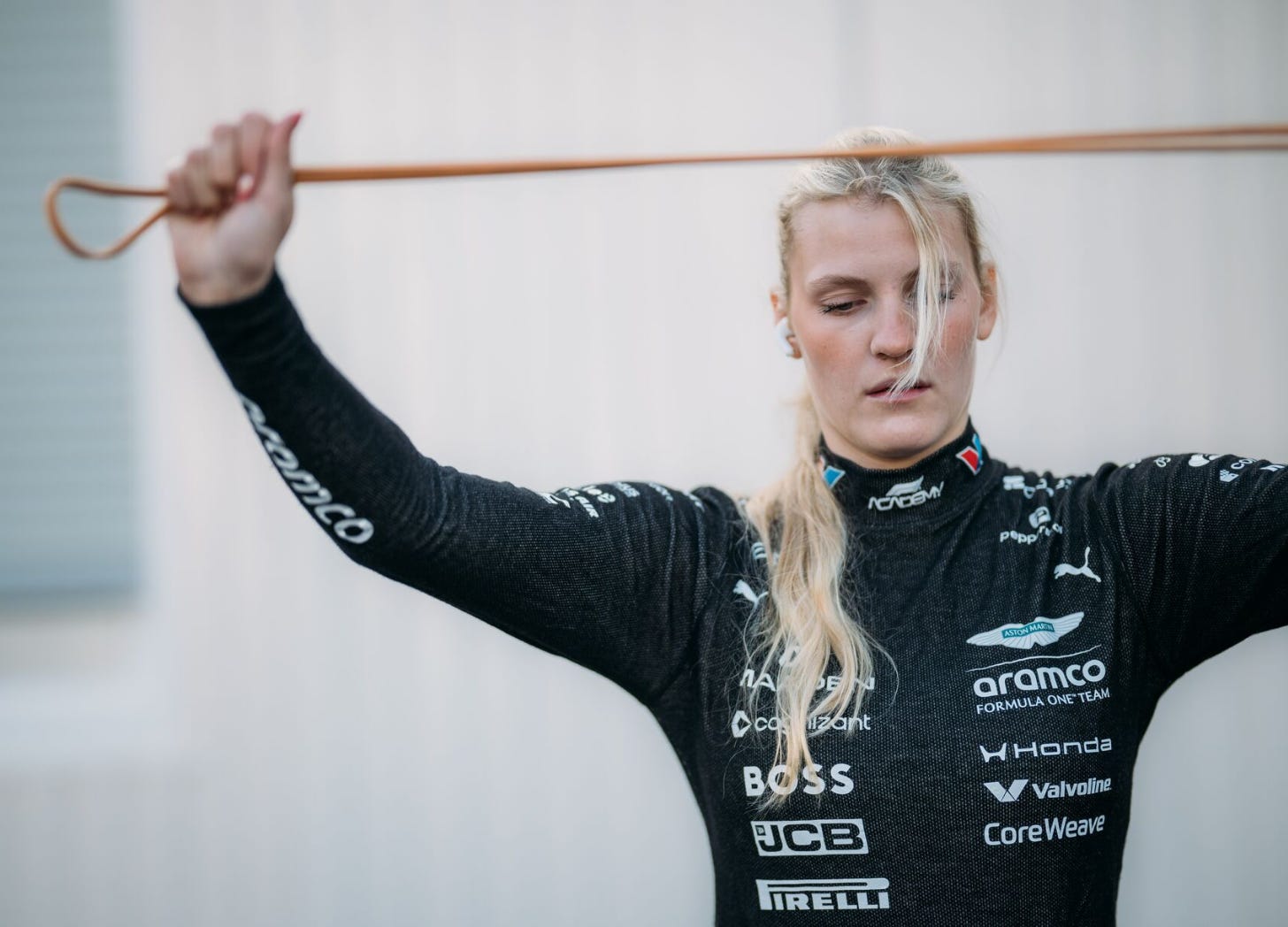
Managing a rookie, though, presents a different challenge. Teaming up with Mathilda Paatz in the #8 Aston Martin car, the partnership has already delivered results in Montreal with the German racer bringing home her first podium in the Opening Race, followed by her maiden win in the Reverse Grid Race later on the same day.
“It’s been quite good working with Mathilda,” she says. “I think the main thing when it’s your rookie year is to take it step by step, get the fundamentals right, and try to adapt as much as you can.”
This measured approach serves as a vital shield against the unique environment of F1 ACADEMY. With direct ties to F1 teams and tremendous media visibility, external pressure can easily overwhelm drivers the moment they enter the paddock.
By framing year one purely around foundational growth, Eimear helps her driver filter out the noise, building the resilience needed to truly deliver when year two arrives. She adds: “Coming into a team like PREMA Racing, we have a lot of good references, especially historically from the past three years for us. It’s a good place to be learning.”
Different Times For The House of Champions
Since the start of F1 ACADEMY, PREMA Racing has been the undisputed powerhouse. They claimed the Teams’ Championship for the first three seasons and housed drivers like Marta Garcia and Doriane Pin, who went on to become Drivers’ Champions.
But 2026 presents a new reality. Currently sitting fourth in the standings, the Italian outfit is navigating a different challenge: fielding an entirely rookie lineup. This shift has required a complete recalibration of what success looks like.
“We have performed in some events; we haven’t performed in others. That can happen,” she explains, pointing out the steep learning curve for rookies tackling new tracks.
Moving away from the expectation of guaranteed sweeps, the focus has shifted to laying solid foundations and managing morale. The pressure to perform in a team like PREMA Racing remains intense, but Eimear shields her drivers by tempering the immediate demand for wins.
“We’ve had to adapt our mentality a little bit for having drivers who are newer to the championship,” she notes. “I think we’re on the right track now to level out the points a bit and try to fight for a few more podiums.”
Fostering A Genuine Bond With Drivers
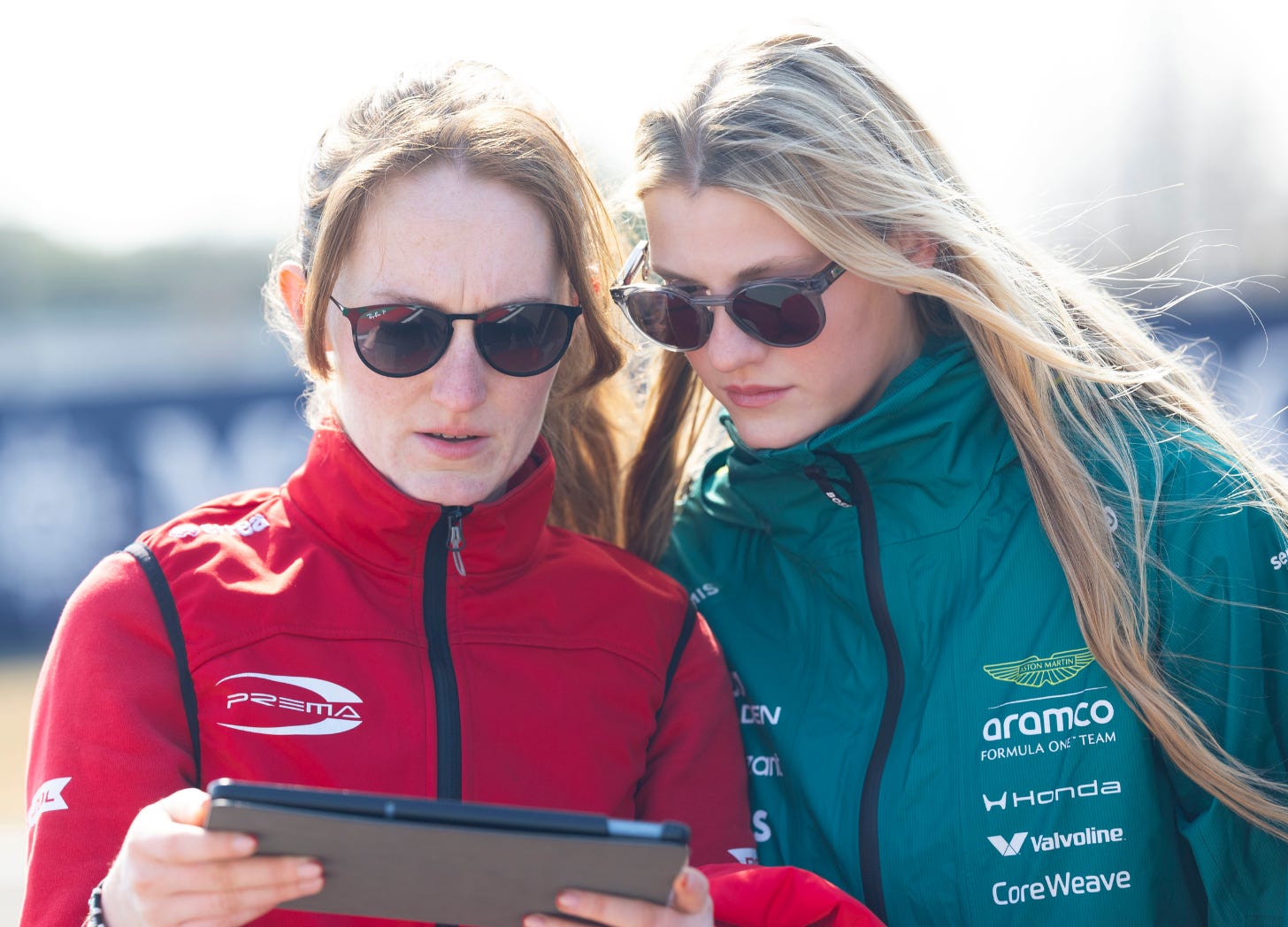
The mental side of race engineering is often invisible, and Eimear’s approach stems from an unexpected place: a decade of coaching in volleyball. That background, alongside mentorship courses, gave her the tools to read, relate, and empathise with people from different backgrounds.
“The key thing is not to treat the driver like they’re just a robot. They are part of the car, ultimately, and they’re the best sensor you probably have. It’s important to treat them like a human, and that involves building a relationship and building trust together.”
That relationship continues outside of the boxes and paddock. While there is a level of professionalism race engineers have to maintain, the line is never set in stone as everyone spends so much time together racing from the start of the season.
What that looks like in practice for a race engineer is maintaining a set of personal standards and expectations. Empathy dictates Eimear’s rhythm, right down to post-session debriefs. “I always chat with the drivers at the start of the season and my rule is normally: After a session, I’m not coming to you. You come to me when you’re ready.”
Handing the driver control over when they process a rough qualifying run or when things do not go their way on track gives them freedom to internalise any emotions they may be feeling before heading into a debrief.
Eimear’s protective instinct over her drivers also extends to the systemic hurdles they face. Reflecting on Maya Weug’s struggle to find a full-time seat in single-seaters, Eimear points to a broader frustration.
“It’s a bit disappointing seeing some of the strongest drivers, if not the strongest driver, come through this championship and not end up finding opportunities that are sustainable to further her career,” she shares.
The upside is that F1 ACADEMY graduates have gone on to achieve remarkable feats: 2025 Drivers’ Champion Doriane Pin became a Development Driver for the Mercedes F1 Team, 2024 Drivers’ Champion Abbi Pulling became the first woman to win a race in GB3, and 2023 Drivers’ Champion Marta Garcia received a fully funded seat to race in the 2024 Formula Regional European Championship.
Still, the traditional pipeline to F3 and F2 remains heavily restricted. “Seeing people progress to FRECA or to GB3, which is a more technically demanding, high-powered car, is a step in the right direction, but it’s the sustainability of keeping them there,” she adds.
“Unfortunately, there doesn’t seem to be a lot of support from external sponsors at the moment. I don’t know what we can do to change it honestly, but it does need to change. We need to see girls getting to F3 at a minimum.”
Finding The Final Tenth
Eimear has come a long way since her days with Imperiale Racing as a Data Engineer. Now in her third season as a Race Engineer in F1 ACADEMY, she knows her job is an exercise in duality.
Telemetry provides the undeniable facts: where a driver is losing time, how the tyres are degrading, or what setup changes are needed. It gives you the baseline to build a fast car.
But extracting that speed requires something a screen can never show — human intuition. And once the racing starts, control shifts to the cockpit. Eimear has to trust that the mental foundation she builds in her drivers is strong enough to handle chaos.
Montreal proved exactly why that matters. A radio failure severed her connection to Mathilda Paatz during a late Safety Car period, forcing the German rookie to navigate the restart purely on gut feel. It was only later that O’Connor managed to restore contact and relay the decisive update about Rafaela Ferreira’s penalty.
As Eimear puts it: “You need to understand your driver quite well to know what they want.”
Great insights from a race engineer on what actually happens during a race weekend! But it was also particularly interesting to learn about the relationship and perspective she has with drivers she worked with in the past.